|
1968 - Classmates Gather in Florida for Fun in the Sun
Writes Andy Forstenzer - “The second annual Wheatley Class of 1968 Alumni Florida Golf Championship, originally scheduled for January, was postponed due to a sudden round of COVID. Rescheduled for March 16, it was almost cancelled again when a teenager from Ohio, texting while driving his father’s large BMW, rammed the rear of David and Cindy Pinter’s Lexus SUV at high speed on the Florida Turnpike just a few days beforehand. While their car was totaled, after Dave and Cindy were both released from the hospital and anxious for a diversion from lingering bruises and pain, a last minute decision was made to shelve any formal competition and instead make the most of a long-awaited social get-together.
To this end, Dave was still able to host a friendly and non-competitive Saturday golf outing at his Gleneagles, Florida vacation resort. The weather was glorious, the course was beautiful, and we thoroughly enjoyed our afternoon.
|
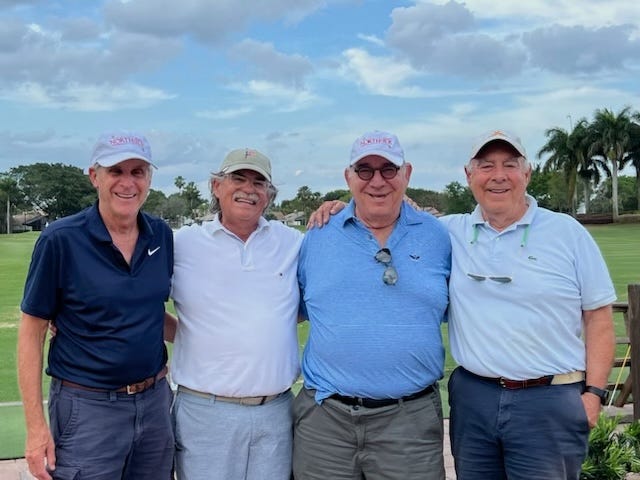
L-R - Andy Forstenzer, Joel Blumenthal, David Pinter, Jon Rosenbloom
Despite there being no competition, Jon ”The Iceman" Rosenbloom easily
walked away with this year's MVP trophy after sinking an extremely difficult,
touch downhill 20-foot putt midway on the back nine and capping off
the afternoon with yet another 20-footer on the final hole, drilling it dead
center into the cup.
Last year, when golf was
finished. we enjoyed only a quick round of drinks at
the mid-Florida course before heading back to our
respective Florida coasts. This year, with spouses in tow, Dave arranged
instead a glorious dinner in downtown Delray Beach, where we were honored to
be joined by classmates, but non-golfers, Tom (Willets Road) and Jill
Silvering (North Side) Glaser.
Enjoying good food, drink and lots of chatter, we stayed until the restaurant
closed before encountering large numbers of St Patty’s Day revelers upon our
departure.
|
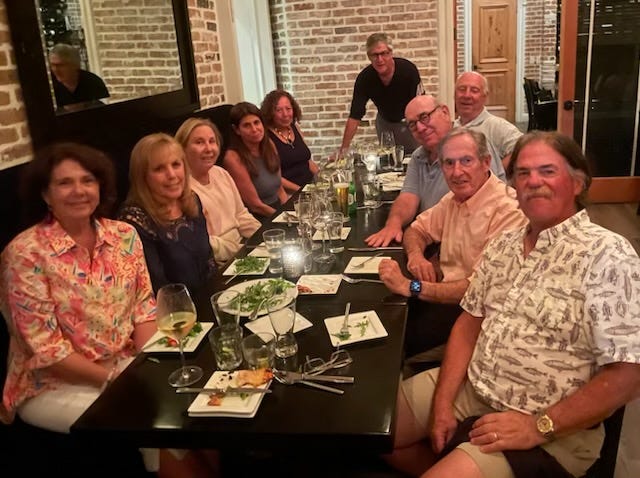
Left Side, L-R - Donna Shirreffs Blumenthal (Joel’s wife), Jill Silvering Glaser (Tom’s wife), Cindy Pinter (David’s wife), Debbie Forstenzer (Andy’s wife), Debra Rosenbloom (Jon’s wife)
Right Side, Front to Back - Joel Blumenthal, Tom Glaser (Jill’s husband), David Pinter, Jon Rosenbloom.
Standing - Andy Forstenzer
Not fully satisfied with the enjoyment of the day, everyone except the Pinters (who had a pre-planned day with their out-of-town visiting daughter) met again for breakfast on Sunday morning at the Glasers’ winter home on Singer Island. The weekend thus ended with yet another fabulous meal, lots of hugs and promises to meet again (perhaps on Florida’s West Coast) next year.
|
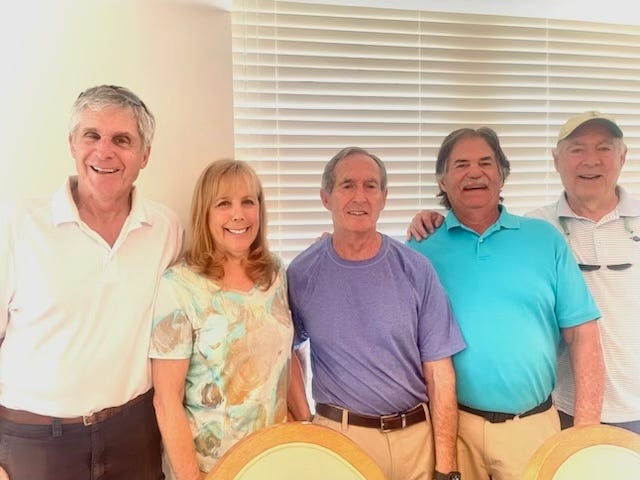
L-R - Andy, Jill, Tom, Joel, Jon
Adds classmate Jon Rosenbloom - “The Willets Road team won the golf competition, informal or not, thereby upholding the honor of our dear elementary school alma mater for the second straight year.”
1974 - Bill Meyn - Memories, Good and Bad
Writes Bill - ”The latest Newsletter brings back a flood of memories, good and bad. My mother died of cancer in 1967 after going though a mastectomy and chemotherapy. I was 11. My father’s remarriage in 1971 caused my departure from Wheatley. These are not happy memories. The alumni issue supporting cancer survivors, along with the mention of the Phipps estate, does bring to mind the many happy memories my mother gave us - learning about nature and art, really about all things. We made family visits to the Phipps Estate, the Teddy Roosevelt Estate, the Vanderbilt Mansion, the Museum of Natural History, and we made many a long walk to the Roslyn Duck Pond. She was fond of artwork as well. We had a seascape on the living room wall and a small pointillist painting of a winter snow scene. I don't remember the artists’ names. I know we could not afford paintings from anyone famous. She was a very "artsy and craftsy" mom. She had all the kids in the neighborhood making things like plastic lanyards, macaroni paintings (macaroni glued on a framed background), crepe-paper flowers, and for a time we had a small kiln in which to bake paint on copper pieces. We did works in clay and paint and pipe cleaners. There was a store called "Champs" somewhere in Mineola that sold arts and crafts supplies. Champs had bins full of things like beads and popsicle sticks.
Some memories are good, some are bad. They all mix together in an impressionistic blur of images that we call ‘memory.’”
1976 - Roberta Finger Corcoran - Writes classmate Lisa Kozupsky Pritchard “Roberta was one of my closest friends in high school and continued until her passing. Roberta was one of the funniest people I have ever known. Her sharp wit of few words illuminated the issue with hilarious clarity. Roberta always had a hand on your back, so you would never fall too hard. Roberta knew what you were going to say, before you ever had the courage of disclosure. Roberta knew her friends that well. Roberta's passing reminds me how blessed I was that she called me her friend.”
1976 - Robin Hegyi Siskind - So sorry to hear about the passing of my classmate Roberta Finger Corcoran. My sincere condolences to Michele Finger Young, her twin sister and our classmate, and her family. On another note, congratulations, Michele, on being named a USA TODAY Woman of the Year, based on your work to put an end to breast cancer ❤️.”
2001 - Scott Reich - Father and Son
OPINIONCOMMENTARYGUEST ESSAYS
My son has a rare disease; we can band together to support research on treatments
|
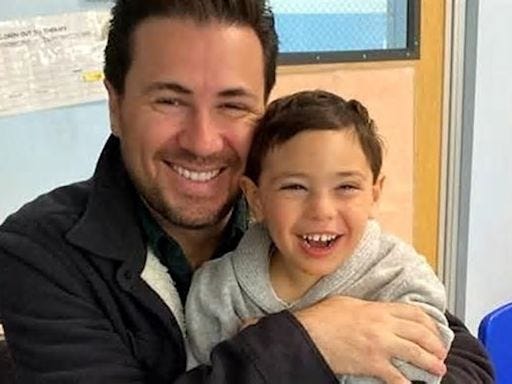
The author, Scott D. Reich, with his son Eli. Credit: Ilissa Reich
By Scott D. Reich Guest essay. March 17, 2024 9:00 am
Until a few years ago, I knew very little about rare diseases. That changed in 2019 when my five-month-old son, Eli, was diagnosed with FOXG1 syndrome, an ultra-rare disease that makes him unable to walk, talk, or do anything independently.
Along this torturous journey, I’ve been surprised to learn how “common” rare diseases are in the aggregate — and how much opportunity exists to address them.
There are more than 10,000 rare diseases, which the National Institutes of Health defines as a disease afflicting fewer than 200,000 people in the U.S. Some 30 to 40 million Americans suffer from rare diseases, 95% of which have no treatment options.
It doesn’t have to be this way.
Recent advances in science and technology have enabled us literally and figuratively to leap into the future, converting sci-fi dreams to reality. Greater access to improved genetic tests has enabled earlier diagnoses. Innovative machine-learning platforms facilitate more effective aggregation of patient data. And new tools like CRISPR have revolutionized our ability to edit genes.
But we’re not quite ‘there’ yet.
We’re still struggling with how to deliver these novel treatments safely. The cost of making new therapeutics remains high, so rare diseases are unattractive for biopharma to pursue, leaving the burden of drug development on impacted families.
But opportunities do exist to improve lives and narrow the gaps we must address as a society.
NIH should shorten review periods to assess novel research proposals and accelerate its decision-making process to award funding. Lengthy processes deter innovation.
To propel more collaboration among scientists working on the same disease, we should link NIH funding those scientists receive to the collaborations we seek. In academia, funding is often tied to peer-reviewed publications of one’s work. This deepens research silos instead of fostering partnership. Stand Up To Cancer’s model of crushing preexisting research silos — by prioritizing the funding of collaborative, cross-institutional research teams — is a model.
We similarly need to reward scientists and patient organizations for sharing information about unsuccessful experiments to increase efficiency. Most experiments don’t achieve the desired aims. Because research is performed in silos, scientists in the same field replicate fruitless work without knowing it, wasting time and money. NIH can centralize access to information and reward scientists who participate.
We must create more financial incentives to attract more investment in the rare disease space. The Food and Drug Administration Safety and Innovation Act of 2012 created a novel voucher program to reward companies for pursuing rare disease research. It’s due to sunset partly in September and fully in 2026. It must be renewed.
We need to help impacted families more quickly organize scientific efforts and accelerate new research in centralized hubs. There is no main place to “go” when one gets a life-changing diagnosis. We need a respected nonprofit destination for rare disease families upon diagnosis. There is power in numbers.
We must build a rare-disease community and direct our efforts toward the common good. No one who gets a rare disease diagnosis is asked who they voted for in the last election, where they pray, whom they love, or any other dividing factor. This is a field that ought to unite us in our shared sense of humanity, to help innocent kids who deserve a shot at life. Let’s get going.
This guest essay reflects the views of Scott D. Reich, a Port Washington father who cofounded the nonprofit Believe in a Cure, which works to develop a treatment for the rare disease that afflicts his son. We Believe in a Cure.Org Website
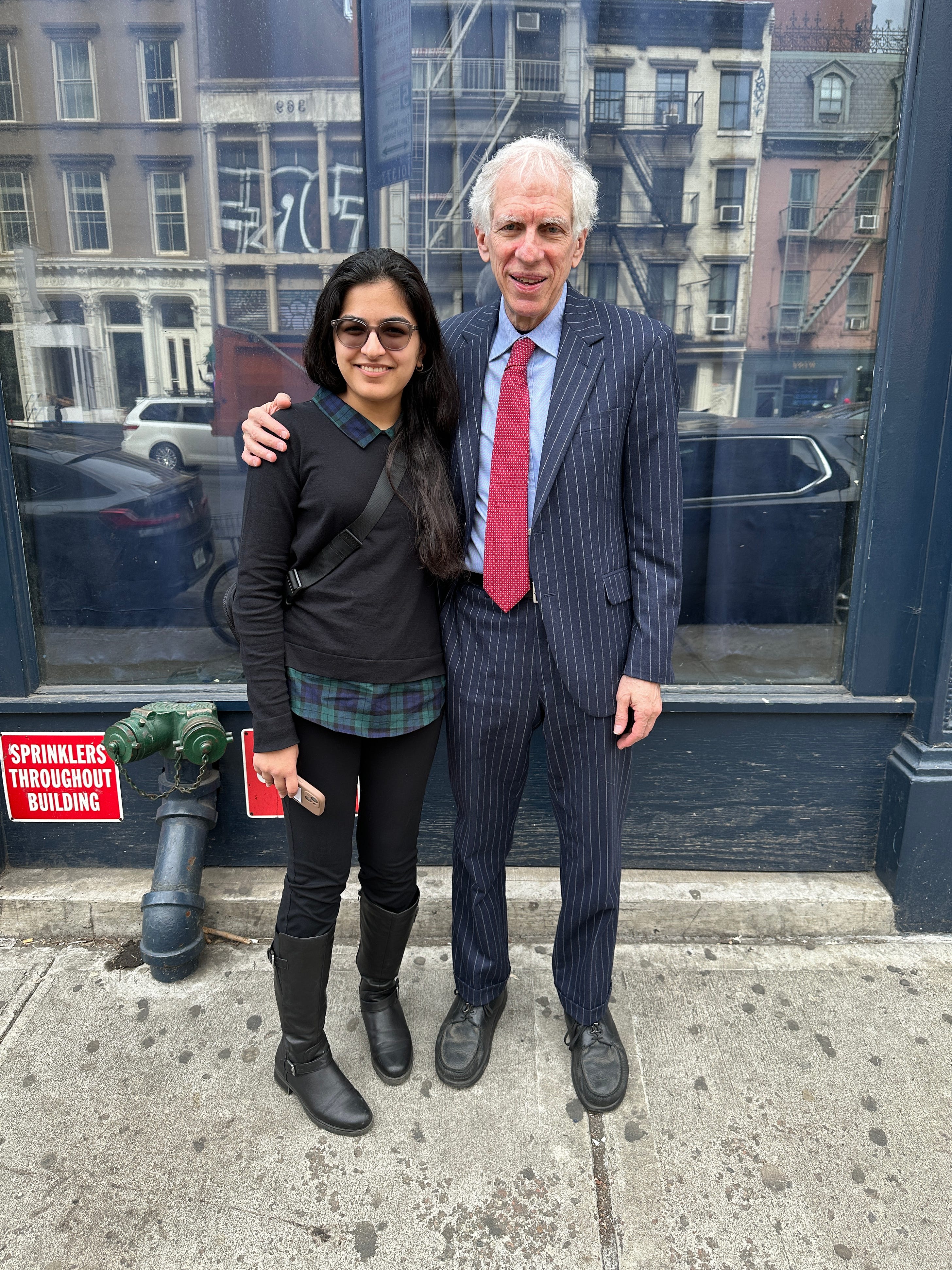
2021 - Anya Chabria - In SoHo, March 15, 2024
|
Fan Mail
Faculty (Karen Bartscherer) - “To read these newsletters is to step into an alternative world where differences of age, profession, life experiences—perhaps even political persuasion—recede, as memories from a shared past and updates on our present day emphasize common ground and goodwill. Like so many of the contributors, I hold countless fond memories of literally hundreds of students and plenty of colleagues from my years at Wheatley. Art and Keith, your time and effort provide all of us chance after chance to revisit some of our “good ol’ days” while catching up with each other, too. That’s one way to make a measurable difference in the lives of many people several times a year, year after year. Thank you both.”
Faculty (Georgette Macrina) - ❤️
1963 (Donna Kenton) - “Hi Art, I think that I can legitimately claim that I was the one who named you ‘The Mayor of Wheatley’ because of all you do and have done for all of us. I’m thrilled to see your sweatshirt! Even the august New York Times mentioned the ‘Mayor’ honorific. You deserve the title. Thank you! Donna”.
1962 (Dick Glassman) - ❤️
1963 (Martin Kay) - ❤️
1965 (Barry Gordon - “Thank you again for another outstanding Wheatley newsletter! I love all the stories and classic photos!”
1965 (Elizabeth Knutson) - ❤️
1965 (Sharon Neely Halm) - “Thanks for all you do for Wheatley Alumni.” ❤️
1968 (Jon Rosenbloom) - “Art, I really appreciate all you do in putting the Wheatley Alumni Newsletter together, and I look forward to every issue!”
1972 (Jeffrey Kargman) - ❤️
1973 (Todd Luttinger) - “Always a great read! Thank you, Artie.” ❤️
1976 (Robin Hegyi Sisskind) - “Thank you for ALL you do for Wheatley.”
1979 (Gwendolyn “Wendy” McClure) - “Thank you, Art.” ❤️
1989 (Peter Sultan) - “I very much enjoy the Wheatley Newsletter and all of the memories it brings up from possibly the best five years of my life.”
1994 (Erica Wolf) - “Thank you for these incredible Newsletters.”
2009 Amanda Hartman Ryan) - “I love the most recent issue of the Newsletter.”
Closing
That’s it for The Wheatley School Alumni Association Newsletter # 142. Please send me your autobiography before someone else sends me your obituary.
Art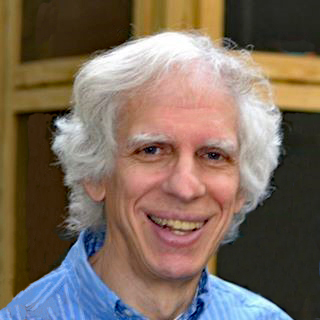 Arthur Fredericks Engoron, Class of 1967
WHEATLEYALUMNI@AOL.COM
ARTENGORON@GMAIL.COM
WWW.WHEATLEYALUMNI.ORG
646-872-4833